


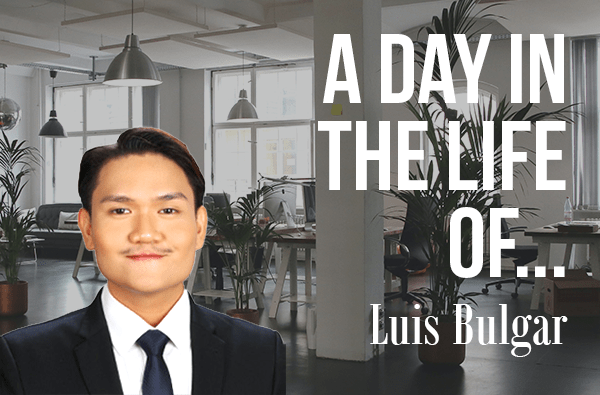
Luis Bulgar
PMO Consultant
University Attended: De La Salle University – Manila
Degree qualification: Bachelor of Arts, Major in Political Science
Year of graduation: 2024
6:30 AM
The sun is up and my alarm is ringing! Another day is here.
6:45 AM
I start getting ready for work putting on my outfit for the day and a bit of sunscreen (can’t skip that!). Before heading out, I do a quick check to make sure I’ve got all my essentials. And of course I never leave without giving my dog a quick kiss goodbye (my non-negotiable part of the morning no matter how late I’m running).
7:30 AM
Most days, I ride with my dad as his workplace is also on the way to mine. Some days, I commute.
8:15 AM
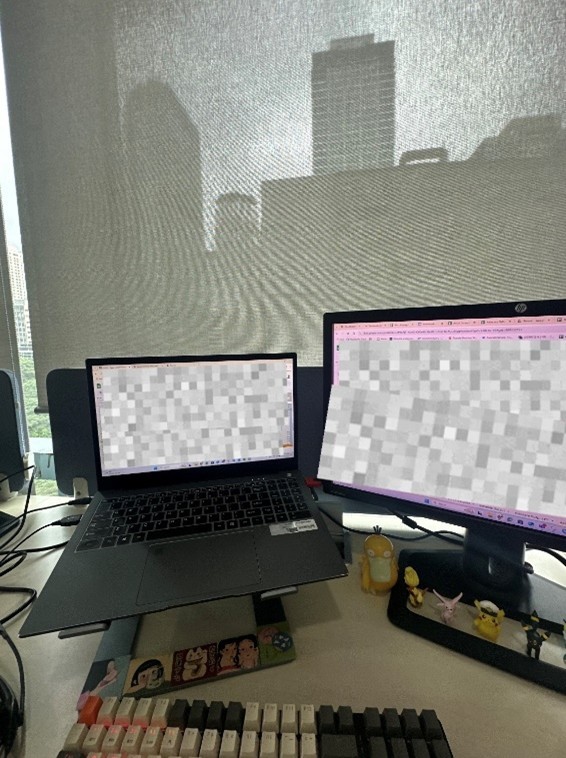
I arrive at the office and set up my workstation: my laptop, wireless mouse and keyboard, notebook and pen, and a monitor for a second screen (I used to think I wouldn’t need a second screen, now I can’t live without it!)
8:30 AM
First thing on my daily agenda is to read through messages and catch up on my emails. An interesting thing about working remote is working with people in different time zones. I’d like to keep a mental note in my head what times people would probably be online and likely to respond to my messages.
8:45 AM
I open my notebook and write down any new information I’ve received and review any pending items. This helps me build my to-do list for the day and prioritise my tasks, from the most urgent and demanding to the lighter ones.
9:00 AM
Once I’m set on my priorities for the day, I quickly go through my calendar to check all scheduled meetings. As part of building my to-do list, I also like to practice time-blocking which turns my calendar into a visual version of my task list. This helps me estimate how long each task will take and identify which ones I can fit in between meetings.
9:15 AM
A daily task that I have is going through our team’s Jira Health Check board. Jira is essentially where team members log their activities along with key details such as ownership, start and end dates, and status of their work. I mostly maintain the hygiene of this health check, making sure none of the team’s Jira tickets are missing critical information or showing as overdue just because someone forgot to update them.
9:45 AM
Once things start to settle, I take a little break to stand up, stretch, and grab some much-needed coffee, coffee, coffee! I usually head out with a few officemates which gives us a nice chance to catch up and check in on how everyone’s day is going.
10:00 AM
I join my first meeting with our team stand up. It’s a quick huddle where everyone shares what they’re working on for the day and the week which helps to align priorities and stay on top of ongoing activities. It’s also a space for anyone to raise risks or issues they’re facing and a great chance for the rest of the team to jump in with suggestions or support to help resolve blockers.
10:30 AM
I take the time to review materials that might come up during next meetings. I make sure all our documents are updated with accurate information and note any incomplete details that need to be verified. At this stage, a major focus should be on forecasting meaning details such as resource allocation, project funding, and estimate approvals are being confirmed or at times updated depending on business priorities.
11:00 AM
I hop on calls with the project managers to go through with them our financial trackers and documents in preparation for the forecast lock. It’s a bit of a routine by now, we double-check effort and estimates, clarify assumptions, and make sure everything lines up before forecast lock day. This usually happens on the first Thursday of each month when projects and programs are required to upload their forecasted spending into the project management system. For our project, most of the focus is on resource costs where everyone is compensated for their work and billed to multiple funding source. It’s a lot of detail to stay on top of but getting it right makes all the difference.
12:30 PM
After meeting with the project managers, I go through the actions I had noted and update our financial trackers and documents. I also reach out to other project managers and program coordinators from different teams to share what I had verified. In turn, I ask for their confirmation and approval just a quick round of validation to make sure we’re all on the same page.
1:15 PM
I step outside the office to grab some lunch. A perfect excuse to stretch my legs and get some fresh air after staring at a screen for a few hours. I usually prefer taking a late lunch as it helps me avoid the long lines and enjoy a bit of quiet. Today’s menu is some Pad Thai and orange chicken from a local spot nearby.

2:00 PM
After a good meal, I open my laptop and check my emails. A few replies have come in from the ones I sent earlier. I go through them one by one, respond where needed, and quickly update the project managers with the new information along with any actions or follow-ups that need to be taken.
2:30 PM
With all the back and forth, it’s easy for project managers to get a bit confused with the information being shared. Since everyone wants to be as accurate as possible, we often end up jumping on quick calls or huddles to double-check that everyone’s doing what they’re supposed to. Things definitely get a little stressful during forecast week and understandably so! We’re all committed to getting the details right the first time and avoiding the extra step of fixing mistakes later. Let’s just say, a little extra patience goes a long way this week.
3:00 PM
As we prepare our financial forecasts for the upcoming month, we also take a step back to review how we actually spent in the previous one. Part of my job is to pull together a variance analysis which is basically comparing what we had forecasted at the start of the month against the actual costs that came in at the end. Sounds easy but no matter how much we plan, surprises still happen so it’s important to keep track.
3:30 PM
I consolidate all this information and prepare the initial sections of the variance analysis report, which I send out to the project managers once the forecast has been locked in.
4:30 PM
At this point, I take a quick scan through any new messages or emails I might have missed, just to make sure nothing urgent has slipped through. I respond to anything that needs my attention right away. Once my inbox looks a little more manageable, I start wrapping up the day’s work.
5:00 PM
Before officially calling it a day, I take one last look at my to-do list to make sure I haven’t missed any priorities. I also start arranging my calendar for the following day and make a note of any remaining pending items from today.
5:30 PM
A quick glance at my after-work routine usually includes hitting the gym, visiting my relatives, or spending a night out in the city with friends. After a long and stressful day like today, unwinding with good company (and maybe a drink or two) feels well deserved. My little way of recharging before another busy day ahead.
More about Luis
What’s your job about?
As a PMO Consultant, I help make sure that governance processes are properly established and consistently followed across the project. The role can take many forms as it ultimately depends on the needs of the project or engagement but at its core, it’s about bringing structure to project delivery. In my current assignment, I work as a project coordinator, providing PMO support to project managers who oversee multiple IT teams. This includes supporting them with forecasting, financial tracking, resource management, and process documentation. Being in this role means staying across the details and making sure every financial and operational aspect of the project runs smoothly. It’s all about finding the right balance between precision and collaboration and keeping everything organised behind the scenes so the team can stay focused on delivering results.
What’s your background?
Fresh out of university with a degree in Political Science, I joined Seven Consulting in 2024 through their Graduate Program. Growing up in Manila taught me the value of hard work, adaptability, and finding structure even in the most fast-paced environments. I’ve always been drawn to roles that come with responsibility and give me the chance to take initiative, especially those that involve planning, coordination, and bringing order to moving parts. That passion for structure and accountability is what led me to Seven Consulting’s Graduate Program, where I’ve been able to turn those strengths into real meaningful work.
Could someone with a different background do your job?
Absolutely! Someone with a different background could definitely do this job but I think what makes each person effective in it is how they approach problem-solving and collaboration. I know Political Science doesn’t have a direct pipeline to project management but my interest in it came from wanting to understand the greater systems that shape people’s lives, how actions influence other actions and how individuals and groups work together within complex structures. In many ways that’s what project management feels like to me too. It’s about evaluating relationships, identifying challenges, and collaborating with different teams to create meaningful and practical solutions.
What’s the coolest thing about your job?
I really like that it can be challenging at times. No two days are ever the same and every situation brings something new which pushes me to think creatively and come up with solutions that actually make things work better. I also love how diverse the environment is. I get to collaborate with and even be mentored by people from different teams, backgrounds, and countries. That mix of perspectives always gives me something new to learn.
What are the limitations of your job?
Definitely not a limitation, but something I needed to get used to. Starting this role at a young age can feel intimidating. You suddenly find yourself in a room full of experienced professionals looking to you for answers and guidance. Although one thing that has really stuck with me from Seven Consulting’s founder Declan Boylan is his advice to never hesitate to ask questions. No matter how simple or annoying you can become, don’t be afraid to learn more about the process. Over time, you gain more experience and confidence to understand your place and why you’re inside that room.
3 pieces of advice for yourself when you were a student…
Always believe in yourself, keep asking questions, and take your time. Slowly understand the rules of life and slowly make yourself better.
